four
A live sampler for norns. Record your synth or drum machine onto four stereo tracks, then loop, stretch, grain and filter the takes as you play.
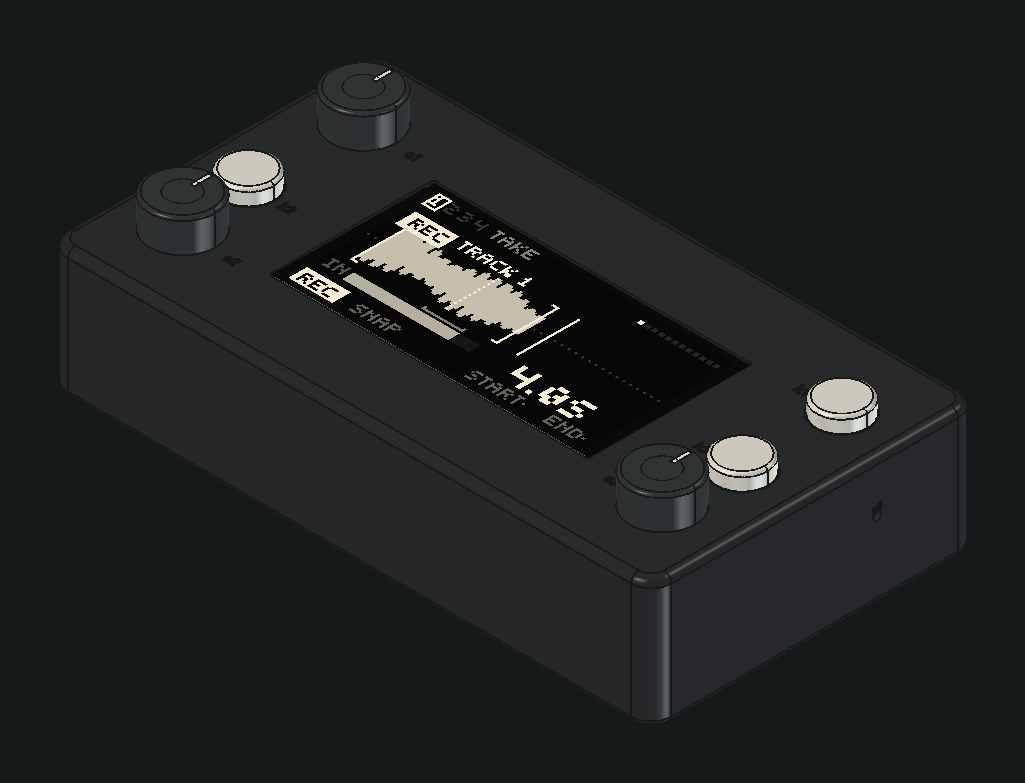
The case is a pocket-sized version of the norns shield, built around a Raspberry Pi Compute Module 4, still in design. Today four runs on a norns shield with a Pi 4.
Switch it on.
Twelve pages, three keys, three encoders
E1 turns the page. The bottom line of the screen names what K2, K3, E2 and E3 do there, and holding K1 swaps in a second set. Most keys latch on a tap. Hold one instead and it lets go when you do.
On every page
- K1 + E1
- Pick the track, 1 to 4. TAKE, VOICE, FILTER and EFFECT edit that one.
- K1 + K2
- Stop everything. Do it again and every head picks up where it stopped.
- K1 + K3
- Tap to switch every effect off. Hold for a second to erase what the page holds: the take, the tape, the motion loop or the scenes.
The machines
The five voices decide how a track reads its take. The other four keep things moving while your hands are busy elsewhere.
The five voices
Machines that play on their own
Inside four
four is a SuperCollider engine like any other norns script, plus a plugin of its own in C++ for the parts where the stock UGens were too heavy or not clean enough. scsynth gets one core of the Pi 4, and everything below shares it.
The path of a sound
- InputAnything at line level, in stereo.
- TakeUp to 60 seconds of stereo on each track.
- VoicePLAY, GRAIN, WARP, PV or CLOUD.
- FilterA diode ladder: low-pass, high-pass or band-pass.
- ColourDrive and crush.
- EffectsTwo slots in a row: chorus, flanger, wobble, resonator, ring or echo.
- SendsTo another track, the delay and the reverb.
- Delay and reverbA bucket brigade delay and a room, shared by all four tracks.
- MixThe tracks against the tape loop, then a limiter.
- OutputStereo. With nothing added, at the level of the take.
Everything from the take to the sends runs once per track. The tape loop is softcut, which runs outside SuperCollider, so it costs the engine nothing.
The engine
- Our own UGens
- FourPV, FourWarp, FourRead, FourGrain, FourDelay, FourBBD, FourRoom, FourTanh and FourCloud (Mutable Instruments Clouds, from the mi-UGens port), in one plugin that installs itself during the restart after the install. Without it, four falls back to stock UGens and still plays.
- What it costs
- Measured on a Raspberry Pi 4 with the reverb and delay on: four PLAY tracks take 17% of the audio thread, four GRAIN tracks 19% and four PV tracks 29%.
- Exact where it can be
- At pitch 1 and speed 1, PLAY gives the take back sample for sample, and so do WARP and PV with the plugin. A track leaves the engine at the level it was recorded.
- Tested
- The C++ cores have their own test program. An offline check renders the real engine on a Mac and holds it to a list of measured targets. Some still fail, and the list says which.
The ideas behind it
Install the public beta
In maiden, type this line, then SYSTEM > RESTART and pick four from SELECT.
;install https://github.com/Alejo-end/four
That restart also puts four's own plugin in place, so the full sound is there from the first load. Nothing to build.
Source and the full guide on GitHub
This is the first public beta. Its known issues are in the release notes.
four is free software under the GNU General Public License v3.
The case is drawn in FreeCAD around a board from KiCad, both open source. The screens are four's own Lua, run offscreen frame by frame. The page uses three.js, GSAP and Lenis, and is set in Hanken Grotesk. This website was built with Claude Code.
made by Alejandro?